

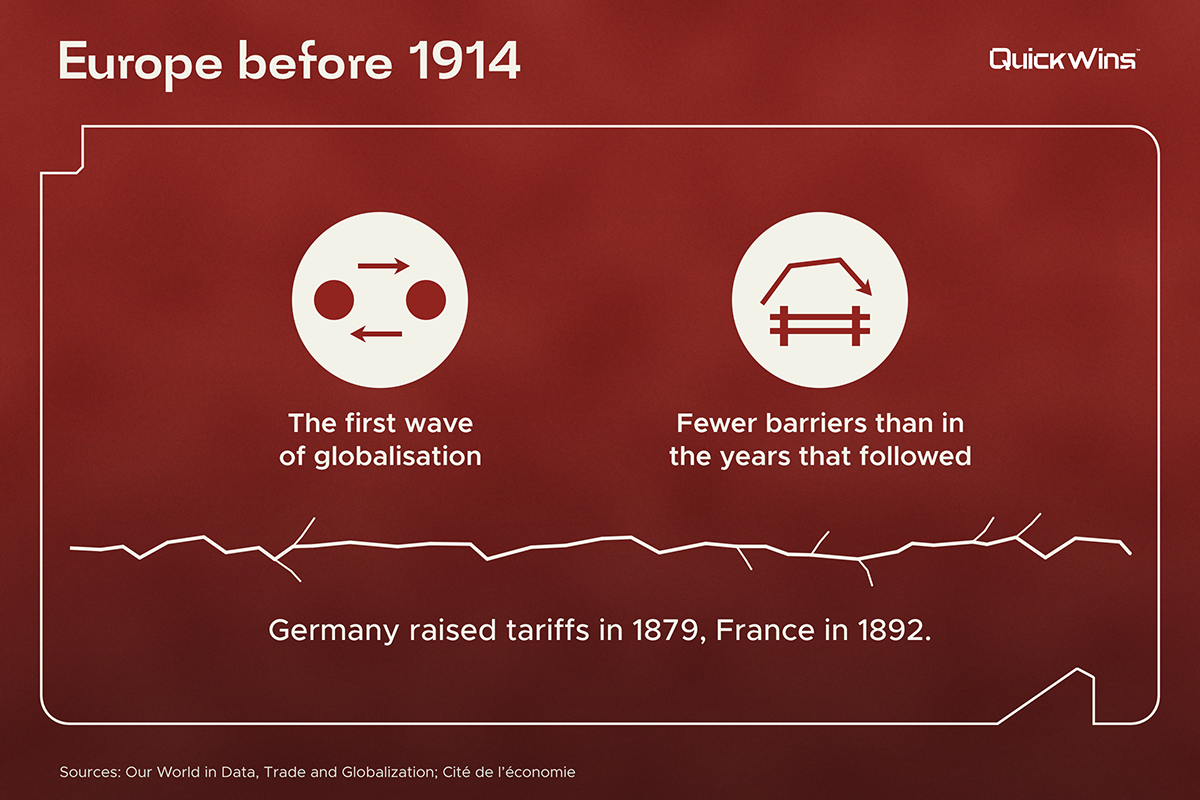
Before 1914, Europe experienced globalization in one of its earliest modern forms. Powered by the Gold Standard, cross-border capital flowed freely, currencies were stable, and trade friction was at an all-time low.
However, beneath this surface stability, structural economic friction was rising, setting the stage for WWI.
Economic Triggers of WWI
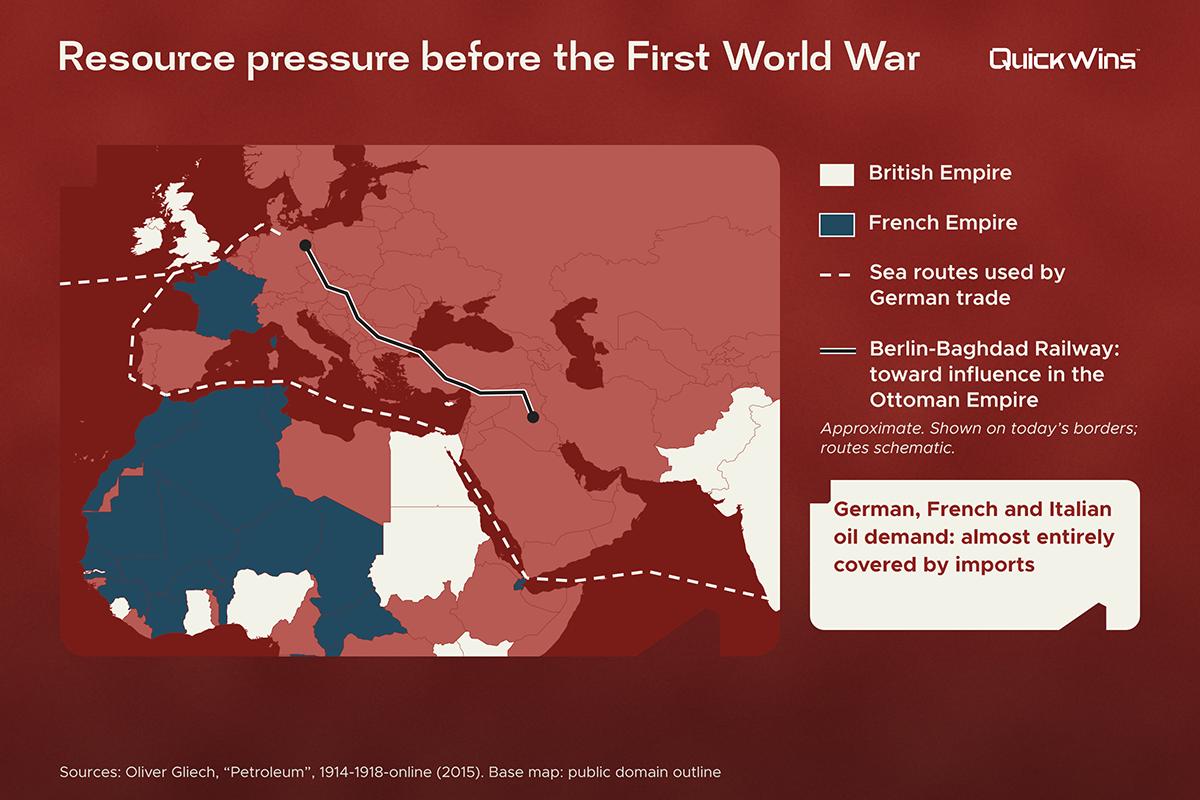
As European industrialization accelerated, domestic resource reserves were rapidly depleted. Manufacturing hubs in Britain, France, and Germany became almost entirely dependent on external imports for critical inputs: oil, rubber, and iron ore.
Instead of relying on open global trade, European powers viewed market dynamics through the lens of Zero-sum Mercantilism: the belief that global wealth was fixed, and one nation's gain was at the expense of another's loss.
To guarantee access to resources, colonial powers like Britain and France expanded their empires into closed trade blocs. Holding a colony meant securing exclusive access to raw materials alongside a captive export market; consequently, non-colonial industrial powers like Germany were left in a weaker economic position.
Germany relied on maritime trade routes controlled by primary rivals to secure its essential resources. To overcome this vulnerability, Germany sought to secure continental trade corridors—such as the Berlin-Baghdad Railway project—to access Middle Eastern oil and expand its sphere of influence.
By 1914, European powers calculated that military conflict was a rational means to secure the industrial inputs their economies required to survive.
Aftermaths of WWI
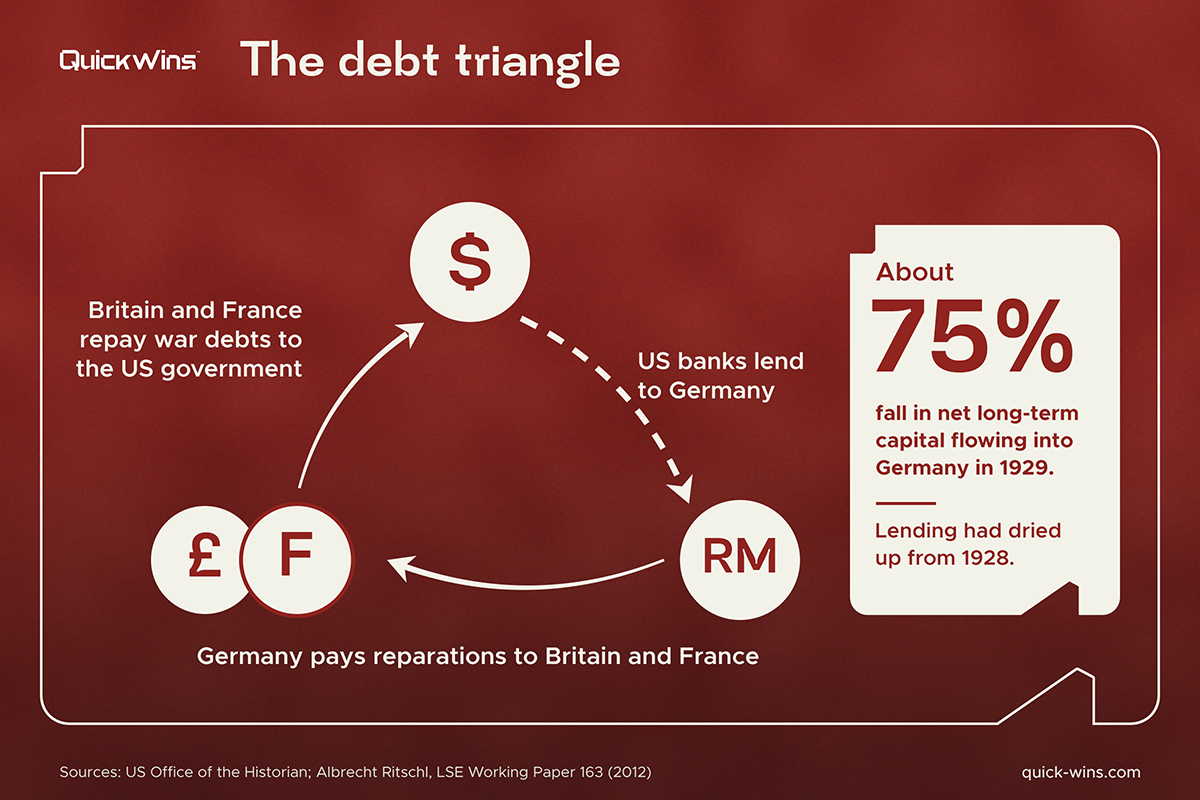
In 1919, WWI officially came to an end after the Treaty of Versailles was signed. The treaty created an unstable financial post-war system built on debt. Britain and France demanded war reparations from Germany that accounted for billions in foreign currency. Meanwhile, they raised tariffs against Germany to protect domestic industries, making it impossible for Germany to raise the needed amount from trade.
To raise the necessary funds, Germany borrowed money from U.S. banks to pay war reparations. In the meantime, Britain and France had outstanding payments to the U.S. government for war debt repayment, so they used the German war reparations to pay them off. This built a vulnerable U.S. Debt Triangle that was deeply dependent on the continuous flow of American loans.
However, when the Wall Street crash of 1929 hit, American capital outflows to Germany dropped by over 80%, collapsing the entire European financial network like a house of cards.
Economic Road to WWII
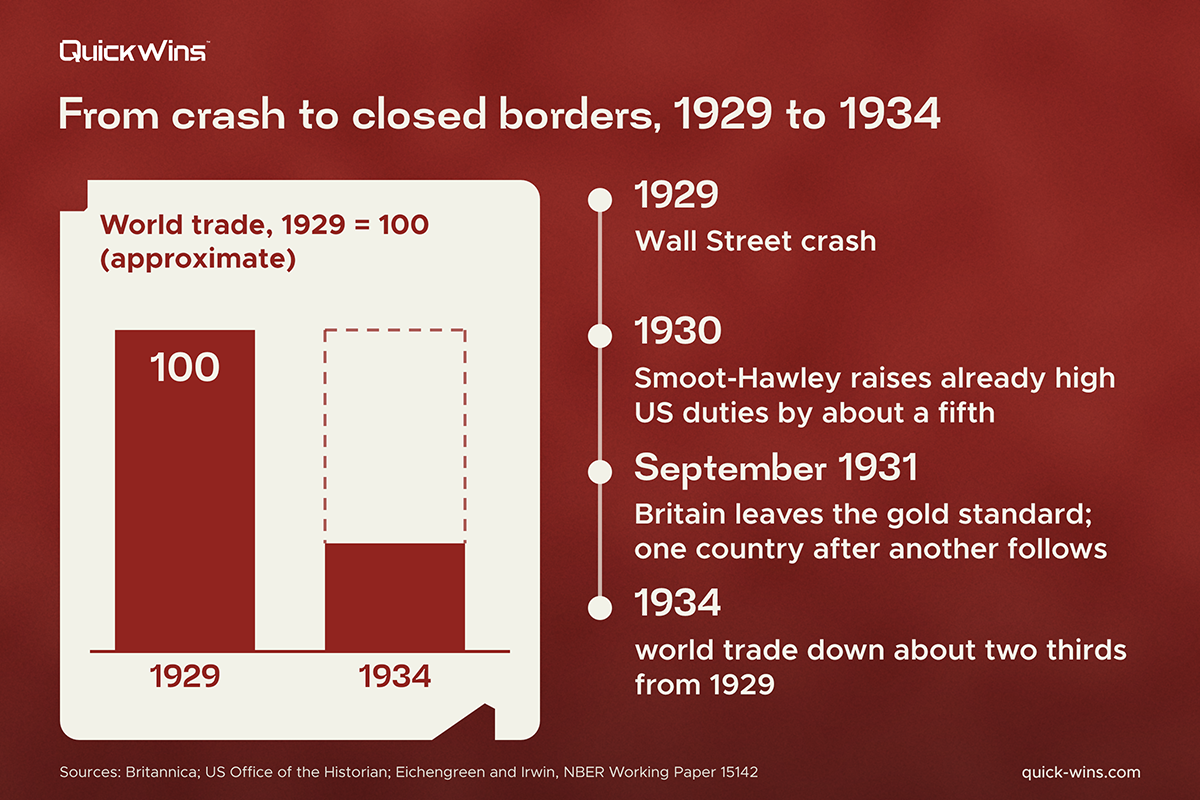
When the Great Depression froze international credit, domestic banking systems across Europe collapsed. Facing unprecedented unemployment levels and severe social unrest, governments retreated into extreme economic nationalism, triggering immediate trade warfare. In 1930, the U.S. passed the Smoot-Hawley Tariff Act, hiking import duties to 60%. European nations struck back immediately with their own trade barriers. Consequently, global trade crashed by 66% between 1929 and 1934.
During the crisis, the Gold Standard forced trade-deficit nations to raise interest rates to restrict capital and gold outflow, worsening domestic investment and unemployment. As the gold reserves shrank, Britain was pushed to abandon the Gold Standard in 1931.
The sudden devaluation of the British pound triggered a wave of beggar-thy-neighbor devaluations, reaching over 40 nations abandoning their gold pegs within the following years in hopes of gaining an economic advantage.
However, due to the simultaneous devaluations, any competitive advantages effectively vanished. This resulted in widespread monetary chaos and exchange-rate collapse, ultimately breaking the Gold Standard and fracturing the world into competing currency blocs, marking the fall of the global financial system.
Outbreak of WWII
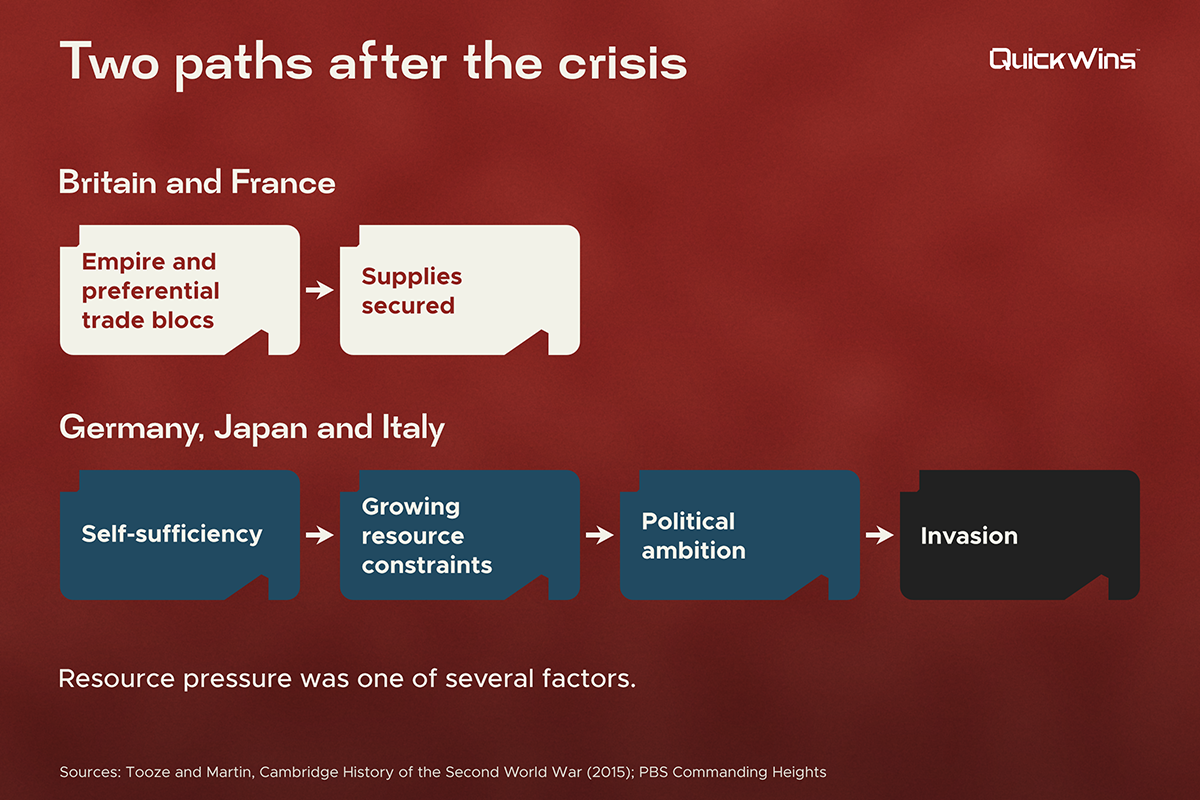
Without a trusted international currency system, nations could no longer rely on standard foreign exchange to purchase essential commodities. Colonial nations Britain and France already had their own closed trade blocs. Conversely, resource-poor industrial powers namely Germany, Japan, and Italy retreated into autarky the pursuit of absolute economic self-sufficiency. However, because autarky is mathematically impossible for resource-poor nations, leaders concluded that military invasion was the only way to secure farmland, oil fields, and mineral reserves.
Conclusion
Mercantilism and trade isolation systematically fracture global trade into closed blocs, forcing non-aligned nations towards economic desperation. Furthermore, weaponized tariff barriers and brittle debt structures leave countries with few alternatives to extreme economic nationalism proving that monetary chaos and closed markets inevitably convert economic vulnerability into military aggression.
