The previous article traced how pre-WWI mercantilism, post-war debt networks, and Great Depression protectionism paved the way for global conflict. But a critical question remains: Why 1939? Why didn’t WWII erupt earlier during the depth of the Great Depression, or years later?
The Economic Timing of WWII
By the late 1930s, the dream of economic self-sufficiency (autarky) quickly faded. While colonial powers like Britain and France relied heavily on their existing empires, resource-poor nations, Germany, Japan, and Italy, were completely isolated. With no foreign currency reserves left to purchase critical imports and essential resources rapidly depleting, their industrial war machines faced economic paralysis.
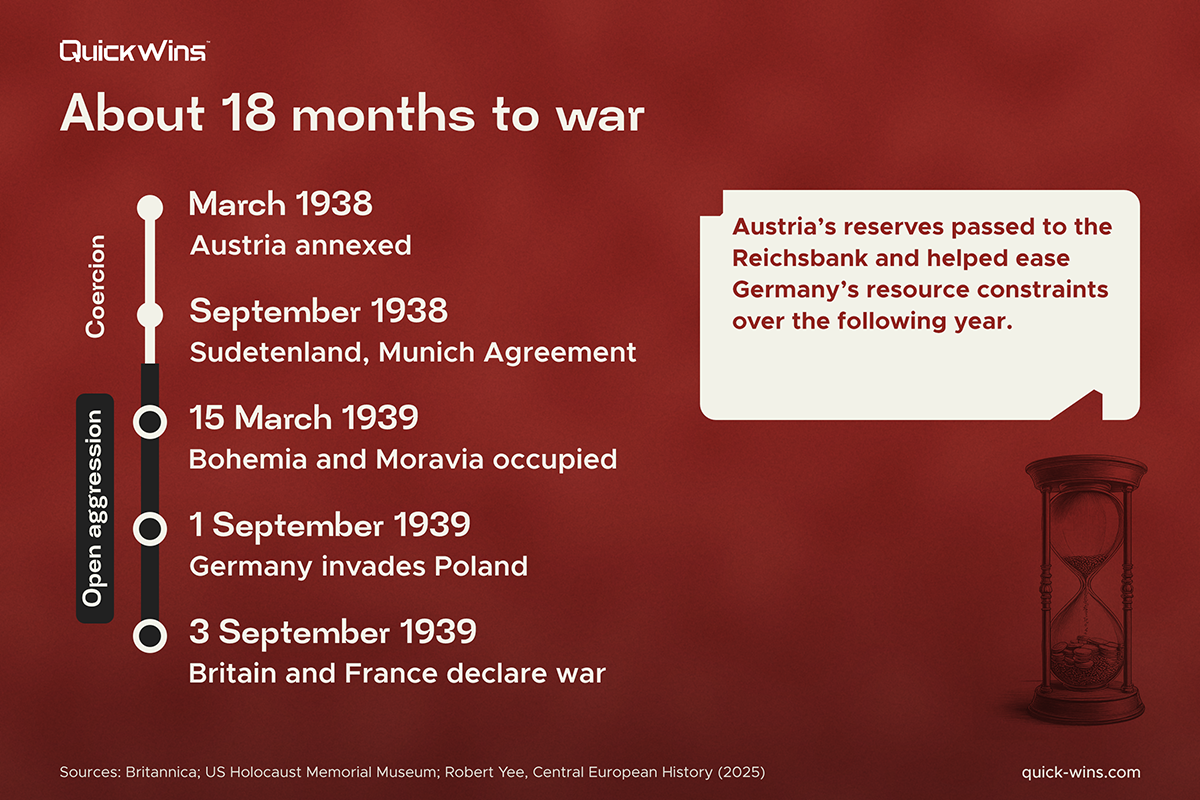
To survive, Nazi Germany initially relied on bloodless diplomatic pressure, annexing Austria and securing the Sudetenland via the Munich Agreement in 1938 to absorb foreign reserves and farmland. But as resource deficits escalated, diplomacy gave way to full-scale military conquest: Germany seized the rest of Czechoslovakia in early 1939 for its heavy arms and invaded Poland on September 1, 1939. Two days later, Britain and France declared war, the desperate search for physical supply chains had officially ignited World War II.
WWII- The Reconstruction Dilemma
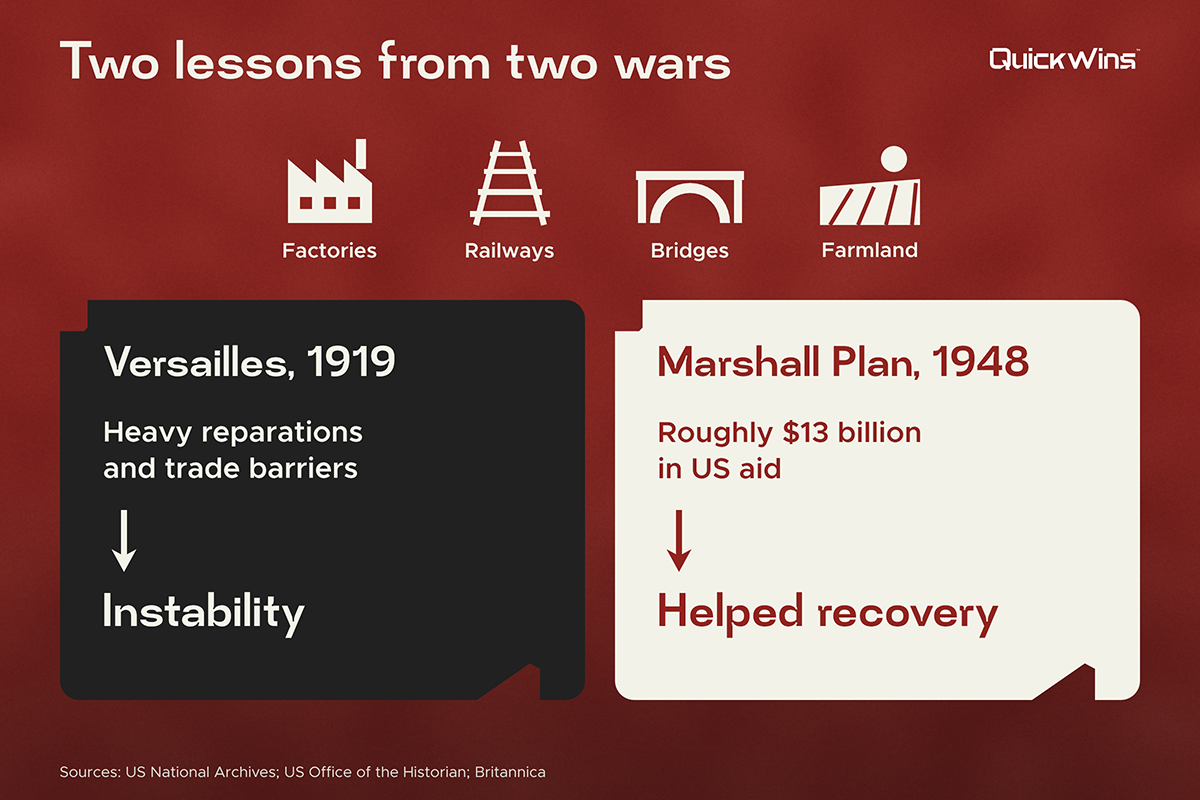
By 1945, as war came to an end, Europe was left in ruin both physically and economically. Factories, railways, bridges, and agricultural fields across Europe were demolished. Coal and steel production was deeply affected. Foreign exchange reserves hit rock-bottom, creating widespread hyperinflation and famine risks.
Post-war leaders faced a profound dilemma: How could Europe be rebuilt as an industrial engine without enabling it to rearm?
Determined to avoid the Versailles Trap of 1919, leaders recognized that demanding massive reparations and establishing trade barriers would inevitably trigger another wave of nationalism and economic collapse. But without reparations, how could a bankrupt continent finance its own reconstruction?
The answer arrived with the Marshall Plan (European Recovery Program) in 1948. Lacking the reserves needed to import food and capital goods, Western Europe received over $13 billion from the U.S. to rebuild infrastructure and revive industrial production, preventing economic collapse.
Yet financial aid alone was not enough to prevent a third world war. European leaders concluded that peace required a permanent, self-enforcing mechanism that would make war economically impossible.
The European Coal and Steel Community (ECSC)
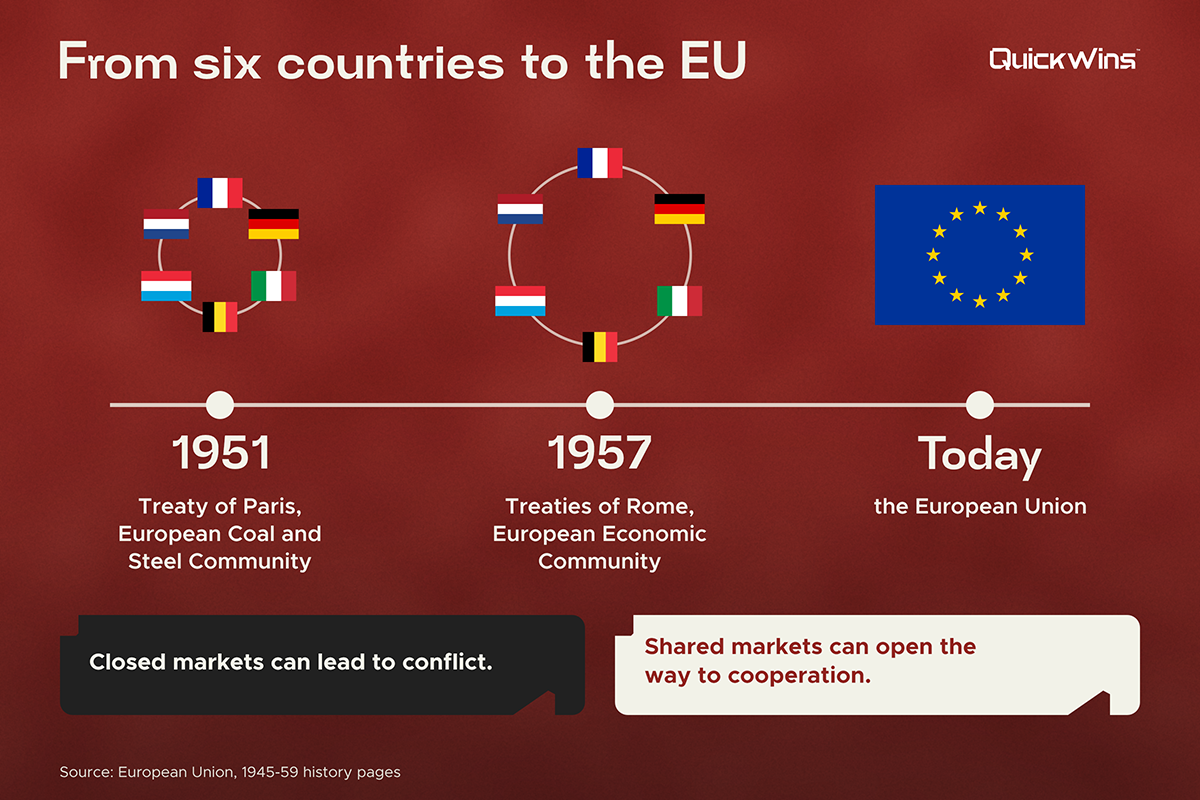
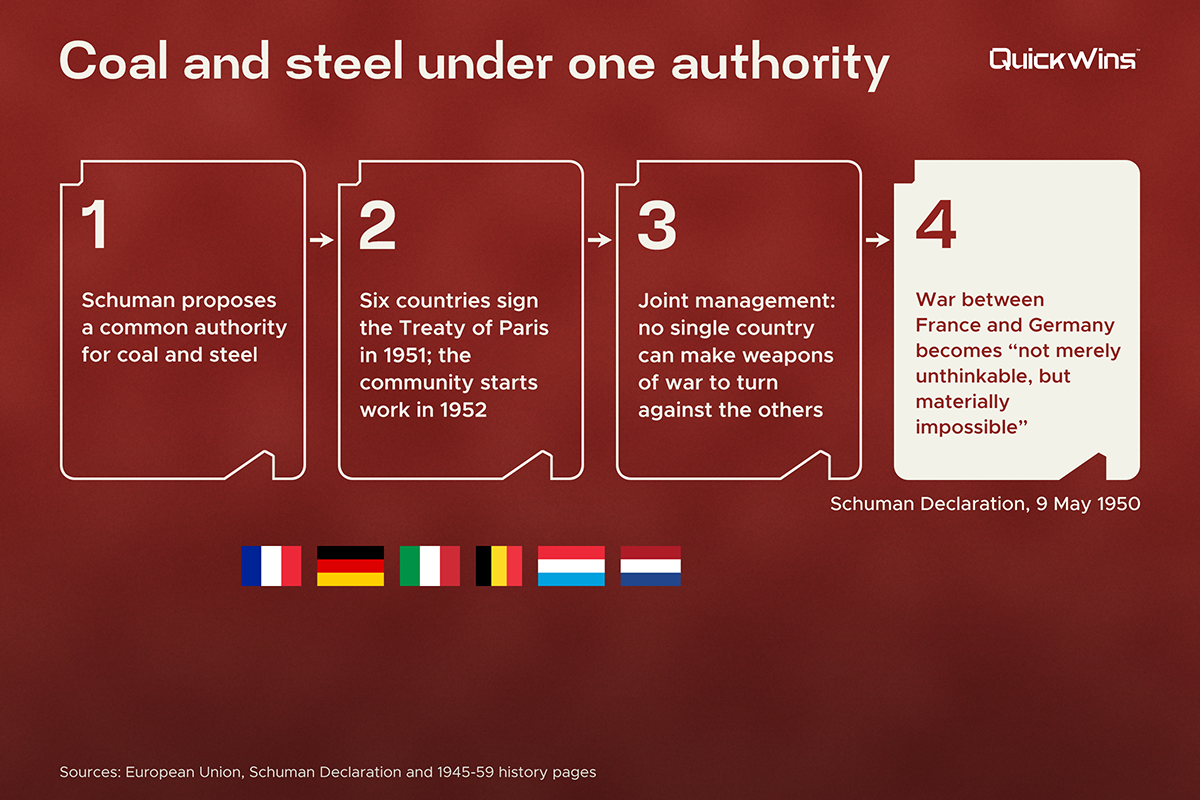
The first step towards the sustainable solution was the Treaty of Paris (1951) that established the European Coal and Steel Community (ECSC), which was signed by France, Italy, Belgium, Luxembourg, the Netherlands, and West Germany.
Coal and steel were the essential inputs for both the reconstruction and the manufacture of military equipment. To prevent nationalism and protectionist measures, the treaty placed both industries under a unified supranational entity.
The goal was to pool essential war inputs across Europe under common management. Thus, the next step was to create a common market to abolish internal tariffs and eliminate market distortions. Consequently, any member state attempting to secretly mobilize for war would instantly disrupt its own domestic supply of coal and steel, paralyzing its industrial economy before manufacturing a single weapon.
The ECSC demonstrated that shared sovereign control over key industrial inputs yielded a far higher return on investment than territorial acquisition. Due to this microeconomic success, the same six nations signed the Treaty of Rome in 1957 to establish the European Economic Community (EEC), setting the stage for the modern-day European Union (EU).
Conclusion
Economic isolation, protectionism, and closed supply chains systematically force nations toward conflict. Conversely, replacing forced resource conquest with shared market governance unlocks continental collaboration, creating a model where peace is no longer a fragile political agreement, but a structural economic necessity.